|
The Avanti (2)
Studebaker's dynamic president, Sherwood Egbert, had been right about one thing. From factory workers to dealers, the new Avanti energized the whole, tired Studebaker organization. It seemed that after two difficult years the company was finally moving again. Well, not quite. Many grave problems were destined to envelop the program before the first Avanti would roll from the production line. The first storm warnings came from Molded Fiberglass in the late spring. They were manufacturing the various body parts, approximately 130 in all. They had also agreed to assemble the bodies, but when they attempted to do so many of the parts refused to fit! Horrified Studebaker engineers rushed to the Ohio plant to somehow make the parts fit, while at the same time sort out the sources of the problems. It wasn't easy. It was June before the first Avanti limped from the assembly line in South Bend, and, in fact, the difficulties were never completely One of the most serious defects was discovered within a few weeks of the beginning of production. The rear window would "pop out" at high speeds due to air pressure. The design was revised, but more valuable time was lost. There was a minor panic when author Ian Fleming, of James Bond fame, ordered an Avanti in black. Black was one of the five original standard colors, but black has the ability to show up every flaw in a body panel, of which there were all too many in the first Avanti bodies. Black was subsequently deleted from the catalogue in favor of gray, a color thought to be more forgiving. (It was later revived as an extra cost option). From the very beginning, sizzling performance had been one of Egbert's requirements for the new car. He now assigned to Andy Granatelli the task of putting the Avanti through its paces. The Avanti was, of course, completely unsuitable for most racing activities but, thanks to its splendid aerodynamic qualities, it was a natural for high-speed runs. As soon as an extra prototype Avanti could be made available, the three Granatelli brothers — Andy, Vince and Joe — were on their way to the Bonneville Salt Flats in Utah. Using a basically stock Avanti powered by an R2 supercharged engine that had been Meanwhile, running changes continued on the Avanti through the early months of 1963. Tom Kellogg, who was assigned to do the 1964 Avanti revisions, as well as the never-built 1965 Studebakers, recalled: "At first, we were going to redesign the round lights. There were also scoops in the front fenders. We had complaints about the cabin overheating. In fact, much of the revision for the '64 was based on customer complaints given us by Egbert. The rain gutters are a good example. Each week he'd go to the Avanti assembly plant with a list of things to be corrected that he discovered by driving his own personal Avanti. It was sort of a "correct this week or else" order...We wanted to make the car more acceptable to a greater number of people. We tied that down in not too long a time, and got on to the square headlights, plus other styling details. We also worked on new interior trim with solid color schemes. Loewy never wanted the solid color interiors." In March the rain drip molding, a surprising oversight in the original design, was added above the side windows. An optional all-black interior color scheme with woodgrain panels was made available in May. The woodgraining was made standard in June (see photo left). Meanwhile, production commenced on the 1964 models in August. Major exterior alterations included squared headlight bezels, a grille covering the front air intake opening, and an extra set of vents on the left side of the cowl. Inside, the solid color idea was expanded to include several color choices besides black, the original delta wing console knobs were redesigned in favor of round ones, and the Studebaker "S" keystone door emblems — known as "pirate buckles" — were made standard. Avanti The real Avanti story for 1964 was under the hood. Two new engines, developed largely through the efforts of the Granatelli brothers, were offered as options. These were known as the R3 and the R4. Both were Studebaker 289 blocks bored out to an absolute maximum 304.5 cubic inches, at which point the cylinder walls were almost thin enough to see the pistons going up and down. Both engines had reworked heads and much larger valves. The R3 was supercharged, while the R4 used twin four-barrel carburetors. The R3 was rated at approximately 335 horsepower, but a properly tuned one was said by Andy's brother, Vince, to be capable of close to 400 horsepower. Only nine R3s were built by Studebaker, although a number of R3 conversions were marketed independently by Paxton. No R4 engines were installed in regular production Avantis, although one reportedly made it into a Lark. Buoyed by these new engines, Studebaker decided to try for some additional performance records in the summer and fall of 1963. They were timed to coincide with the introduction of the 1964 models. An entire fleet of Studebakers was involved this time, from the lowliest six-cylinder Commander to the exalted R3 Avanti. Just to add some special excitement, the Granatellis also put together a mind-boggling R5 Avanti, known as the "Due Centro," equipped with twin superchargers. The R5 used the semi-standard 304.5 block. A special grind camshaft was used, ground to Paxton Products specifications. A magneto ignition system supplied the spark. The induction system utilized dual Paxton superchargers, one for each cylinder bank, paired with a single Bendix fuel injection system. (This was the system originally developed for the Novi V8 racing engines.) The engine ran a dry sump oil system with an oil reservoir and oil cooler. The R5 was redlined at 7,000 RPM and developed approximately 575 horsepower. First, an R2 Avanti, sponsored by Sears and using ordinary All-State Guardsman 6.70x15 tires, was driven on four fast coast-to-coast trips. New York-to-San Diego was done in 52 hours and 6 minutes. Los Angeles-to-New York was done in even less: 49 hours and 36 minutes. The car was then brought to the Bonneville Salt Flats in October where Joe Granatelli, using the same engine and tires, made a run of 147 mph. Then Andy, with three passengers, made a leisurely run at nearly 143 mph! Then the team got down to serious business with the entire fleet. Speed records in the flying kilometer ranged from 59.8 mph in the six cylinder Commander to a stunning 196.62 in the "Due Centro" Avanti. All in all, using twelve cars over a period of five days, 72 USAC records were set in half a dozen different classes. In addition to Granatelli's efforts, Studebaker was still a hot topic with the nation's news media. In September, the company announced to dealers that it had managed to place an Avanti on the popular television program, "The Price Is Right," as a grand prize. This was supposed to heighten public awareness of the Avanti (and of Studebaker, of course) in the weeks stretching from mid-September through mid-October. Concurrently, a special "Avanti Inventory and Retail Program Contest" was announced for the dealers. In the end, it all came to naught. The 3,834 Avantis built during the 1963 model year generated neither the publicity nor profits needed to save the day for Studebaker. The 809 units turned out before the Avanti's abbreviated 1964 model run ended were, by that point, little more than a footnote to the story. So, the Avanti was a failure in hard, commercial terms. But, it was a glorious failure and was, without a doubt, one of the most significant cars produced in America in the postwar era. It was the first car in this country to have modern disc brakes. It pioneered the concept of designed-in safety that the government later picked-up with a vengeance. Its aerodynamic wedge shape, which seemed so astounding at the time, is suddenly the norm. It was more than a pretty face, it was immensely influential. If the Avanti proved to be Studebaker's swan song, it was an unforgettable one.
|
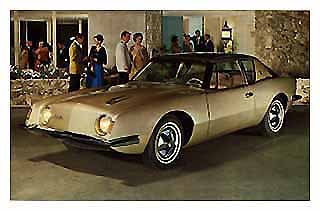 overcome. A program of running changes was instituted to attempt to keep up with the engineers as well as the service people in the field.
 bored to 299 cubic inches, they set two major American class C records: a two-way flying mile record of 168.15 mph, and a standing start mile record of 92.03 mph.
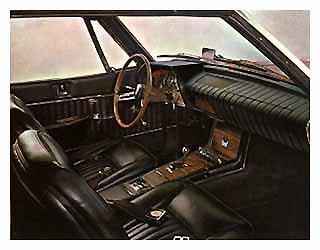 production changes were not always made with precision, and there are some cars titled as 1964s that still have the round headlight bezels which remained available as a no cost option.